
Dancing Lights: What Motion Leaves Behind
A Visual Study of Movement, Color, and Awareness
Dancing Lights may first appear to be a collection of abstract photographs.
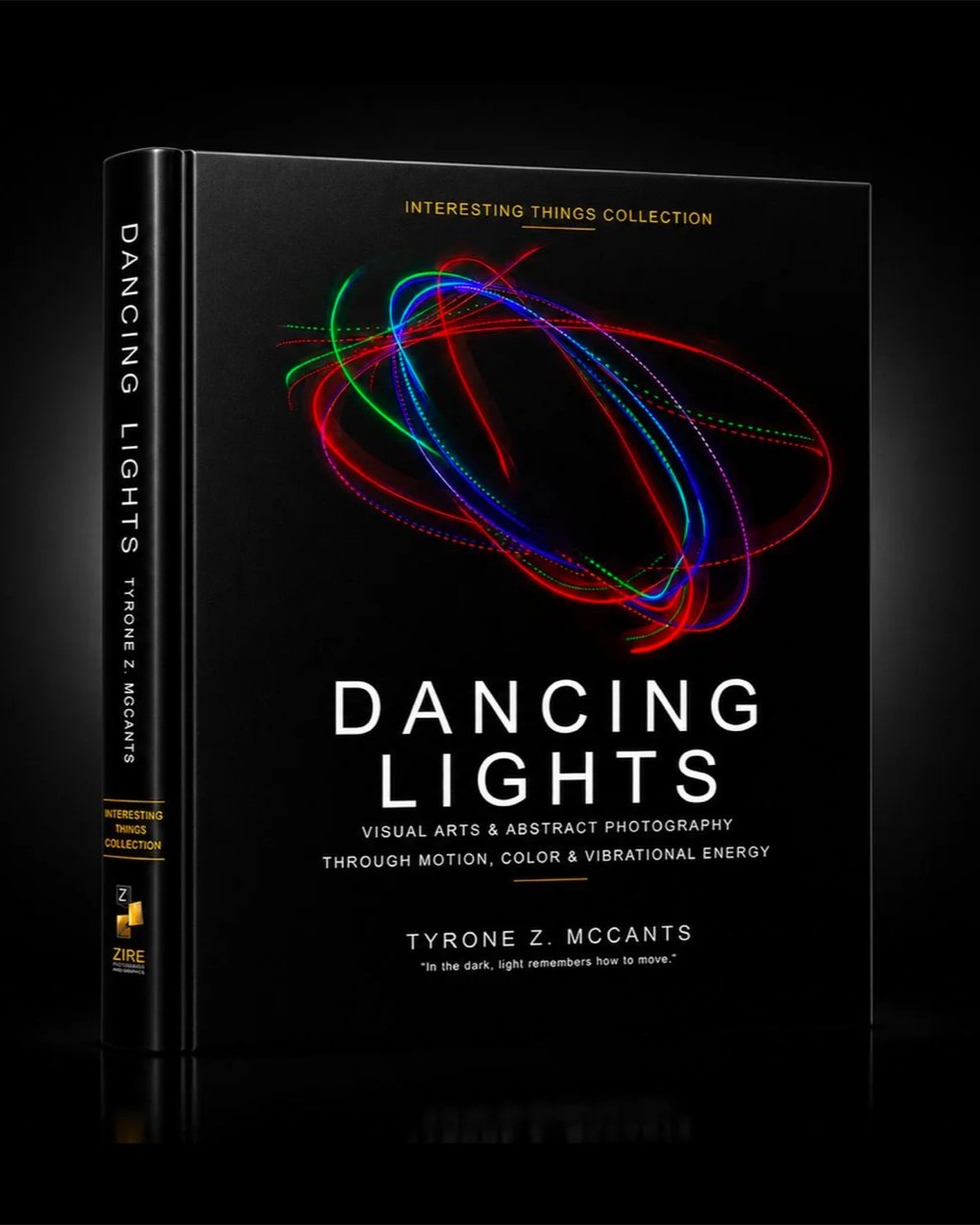
Dancing Lights is a fine-art photography collection by visual artist and photographer Tyrone Z. McCants that explores awareness, perception, motion, and the hidden patterns that shape our experience of the world.
Streams of color move across dark backgrounds. Lines bend, collide, separate, and form shapes that seem to exist between intention and chance.
But the project is not simply about photographing light.
It is about studying what movement leaves behind.
Long-exposure photography records time differently from ordinary vision. The human eye experiences motion as something immediate. The camera can extend that moment, allowing movement to create a visible trace.
That trace becomes a record.
A gesture becomes a line.
Energy becomes form.
Time becomes composition.
The resulting images ask the viewer to reconsider what was present inside an ordinary moment but could not be fully seen.
That is where Dancing Lights connects to observation.
The project investigates how perception influences understanding. Two people can witness the same event and recognize different patterns. One sees random movement. Another sees rhythm. One sees darkness. Another recognizes how darkness allows light to reveal its structure.
The photographs also reflect emotional and physical energy.
Some images feel controlled and balanced.
Others appear restless, forceful, expanding, or uncertain.
The work does not dictate one emotional interpretation. It creates space for viewers to identify their own associations within the movement.
That relationship between the image and viewer is central to the collection.
Dancing Lights is not asking audiences only to admire color.
It is asking them to examine perception.
What do you recognize?
What do you overlook?
What changes when time is extended?
What becomes visible when the familiar is removed?
Through motion, darkness, color, and light, the project demonstrates a larger principle:
Ordinary moments can hold extraordinary structures when we develop the discipline to observe them.
And in darkness, light remembers how to move.
