
Ancient Earth, Eternal Sky: Papago Buttes and Camelback


Various Places · Phoenix, Arizona
Ancient Earth, Eternal Sky
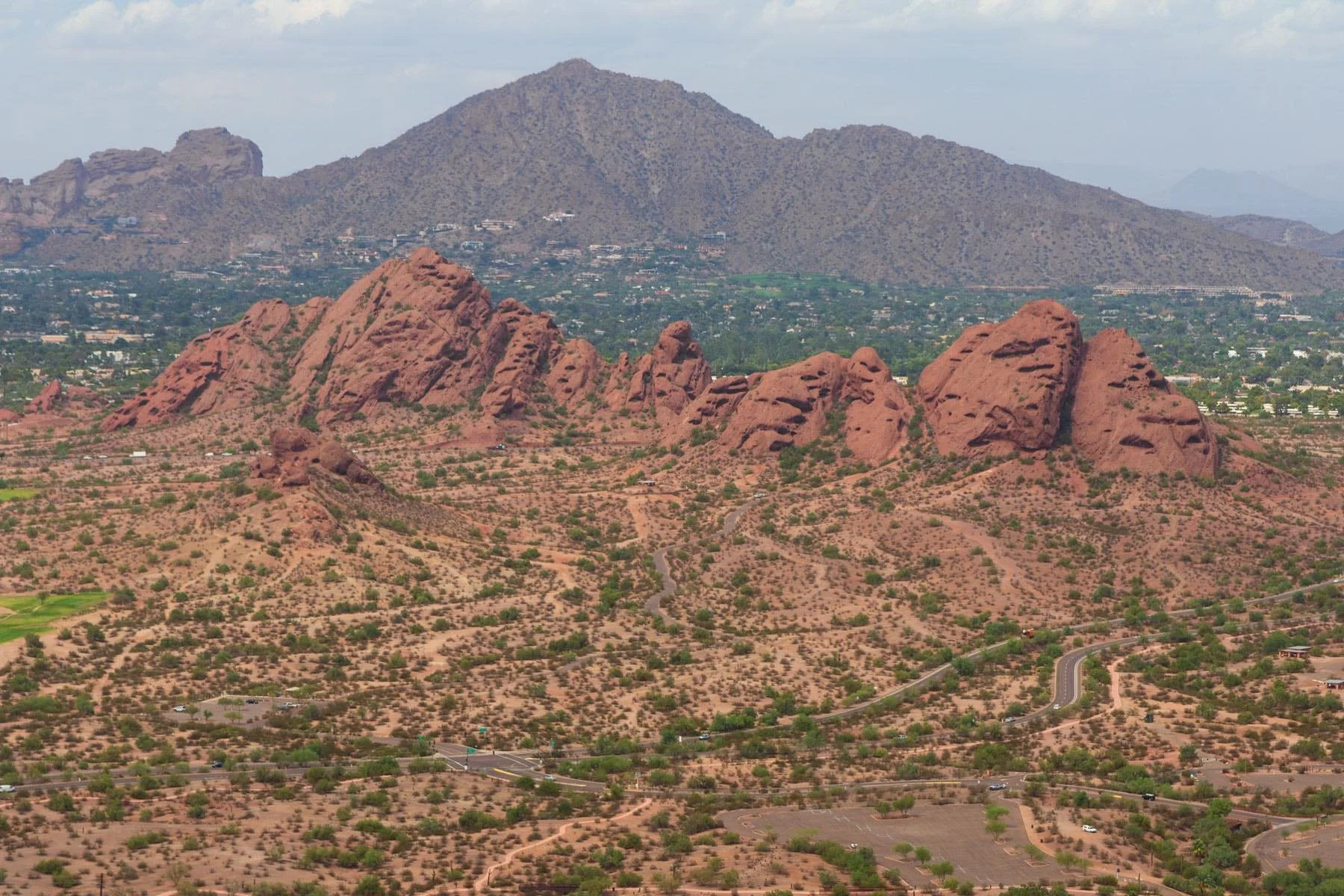
From an elevated view over the Papago Buttes, Camelback Mountain, desert stone, and modern Phoenix settle into one long record of time.
Most views of Phoenix ask you to choose: the desert or the city, the mountain or the neighborhoods spread out beneath it. This photograph refuses the choice.
Looking out across the Papago Buttes in Papago Park, the frame holds weathered red sandstone in the foreground, Camelback Mountain along the distant horizon, and everything in between — roads, green spaces, rooftops — arranged as layers rather than competitors. The city is present. It simply isn’t alone.
Reading the Frame
Color does the structural work here. The buttes move through terracotta, burnt orange, rust, and desert tan. Sage and olive vegetation rise out of those earth tones. Farther back, the palette cools into atmospheric blue and mountain gray, and the eye travels with it — near to far, warm to cool, ground to horizon.
- Terracotta
- Burnt orange
- Rust
- Desert tan
- Sage
- Olive
- Atmospheric blue
- Mountain gray
That progression isn’t decoration. It shows distance and age, and where the land ends and the built city begins — or, more honestly, where the two keep overlapping.
Deep Time in a Single Mountain
Camelback Mountain carries more history than its silhouette suggests. Two formations of very different ages meet along an unconformity—a gap in the rock record. One is Precambrian granite roughly 1.5 billion years old. The other is red sandstone laid down around 25 million years ago.
The red rock of the Papago Buttes in the foreground is younger still. Papago Park’s sandstone formed roughly 6 to 15 million years ago and has since weathered into the rounded shapes and openings the park is known for.
Read that way, the photograph spans more than a billion years from front to back — and the city occupies the thinnest slice of it.
The Long Memory of the Valley
Long before Phoenix, the Salt River Valley was Hohokam country. The Hohokam farmed this desert by moving water through it, building canal networks counted among the most complex in the pre-contact Western Hemisphere. Floods in the 1300s broke much of that system apart. Parts of it were later renovated and still help carry the city’s water today.
There is evidence that the Hohokam used the openings in Papago Park’s rock to track the solstices, and a cave on Camelback’s north side suggests the mountain was a sacred place to them.
None of that is visible in the frame. That is the point. The photograph shows the surface of a place whose memory runs deeper than the eye can hold, and it asks the viewer to consider what sits underneath.
Through Zire’s Lens
Zire approached the scene through observation rather than spectacle. He was drawn to the relationship between foreground and horizon: the Papago formations standing like natural monuments up close, Camelback anchoring the distance, and the city occupying the space between them without erasing the land.
Ancient terrain doesn’t disappear when development arrives.
It keeps shaping the roads, the neighborhoods, the sightlines, and the way people understand where they live. That balance is the argument of the image.
From the Archive to the Wall and the Road
The photograph lives beyond the screen. It is available as a horizontal fine-art print, and its visual language — terrain, elevation, earth tone, travel — carries into the Land Trekker Collection from Canvas Art Products, where landscape becomes wearable art.
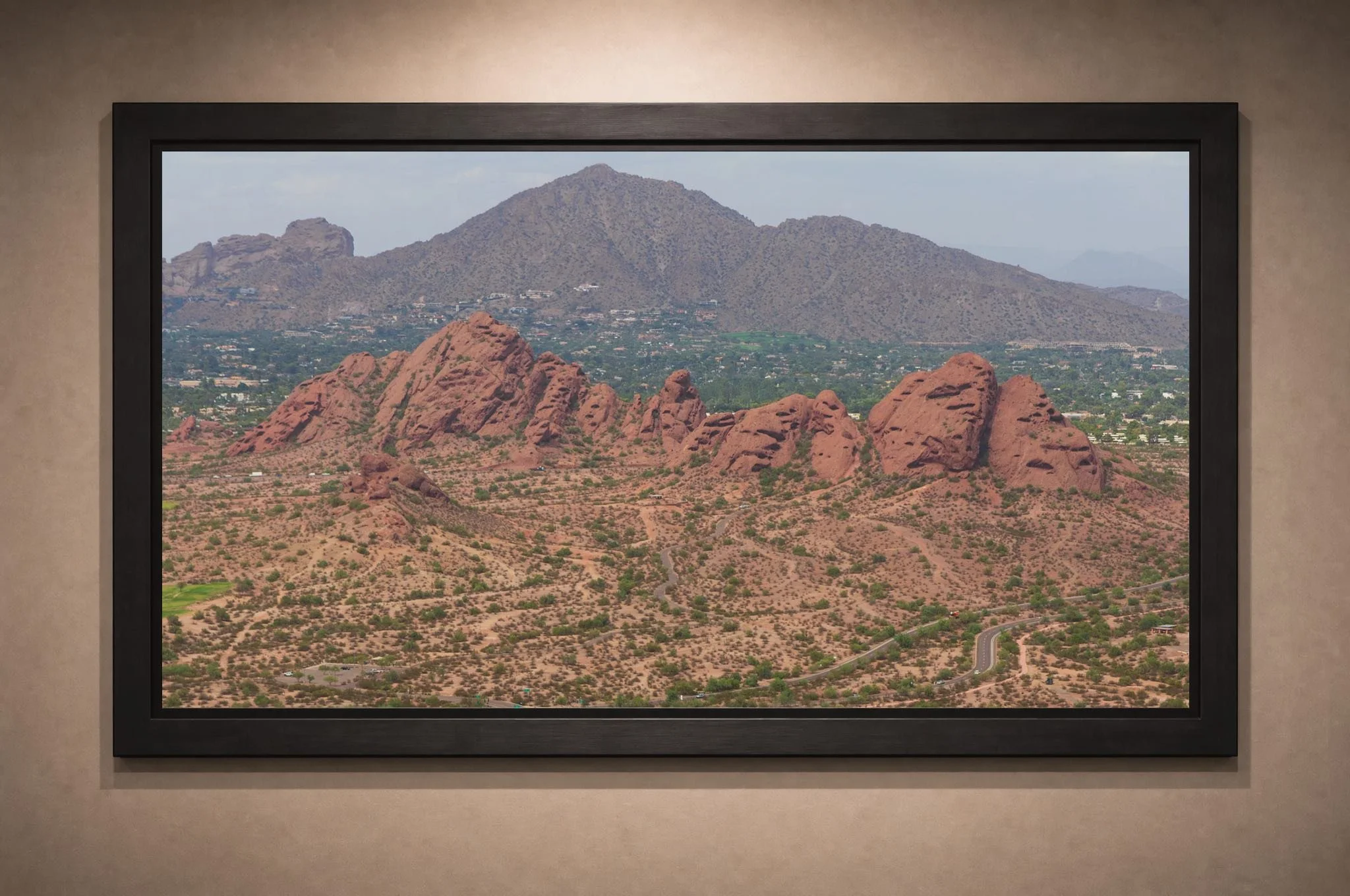


One keeps the land on the wall. The other carries it into the journey.
Related Archive Pathways
What the Land Keeps
Phoenix will keep growing. Roads will widen, neighborhoods will fill in, the skyline will change. The buttes and the mountain will still be there, holding time at a scale no city can match.
A photograph can’t stop that change. What it can do is keep an honest record of a moment when the land and the city were seen together — and remind whoever looks at it later that the ground beneath them was here first.
