
Erykah Badu at the Fabulous Fox Theatre



JAZZY NIGHTS & BLUES · BLINK STL
Erykah Badu at the Fabulous Fox
The Night Live Music Returned to St. Louis.
A Photographer Returns to Live Music
St. Louis was ready to hear live music again.
The lights inside the Fabulous Fox Theatre began to fall, and I checked my camera one final time.
After months of photographing quiet streets, restricted gatherings, and the visual emptiness created by the pandemic, I was standing in front of a stage again.
A nearly full theater waited behind me. Musicians prepared beyond the curtain. The energy in the room felt larger than anticipation.
On October 16, 2021, Erykah Badu stepped onto the Fabulous Fox stage and transformed that return into something deeper than a concert.
“The performance became a public exhale — a moment when sound, community, memory, and movement returned to the same room.”
I was there covering the evening through Jazzy Nights & Blues and BLINK STL, documenting one of the most meaningful live performances I experienced during my time in St. Louis.

Before the Music
The gathering already felt ceremonial.
People arrived in African prints, earth tones, vintage fashion, bold accessories, and contemporary street style.
The gathering felt part concert, part family reunion, and part cultural celebration.
Health requirements and entry protocols were still part of public life, but they did not diminish the mood.
The audience understood the importance of the moment. We were not only attending a performance. We were slowly reclaiming shared space.
Live music had always been central to the cultural identity of St. Louis. Blues, jazz, soul, gospel, funk, and hip-hop are not separate histories here.
They live beside one another, carried through families, neighborhoods, radio stations, venues, and generations of working musicians.
The Band Builds the Room
Costume, cultural timestamp, and musical foundation.
Media photographers were permitted to document only the opening portion of the performance, which meant every frame had to count.
Badu’s band appeared first, dressed in full-body protective-style stagewear that visually referenced the pandemic period everyone in the room had survived.
What could have felt clinical became theatrical. The clothing served as both costume and cultural timestamp.
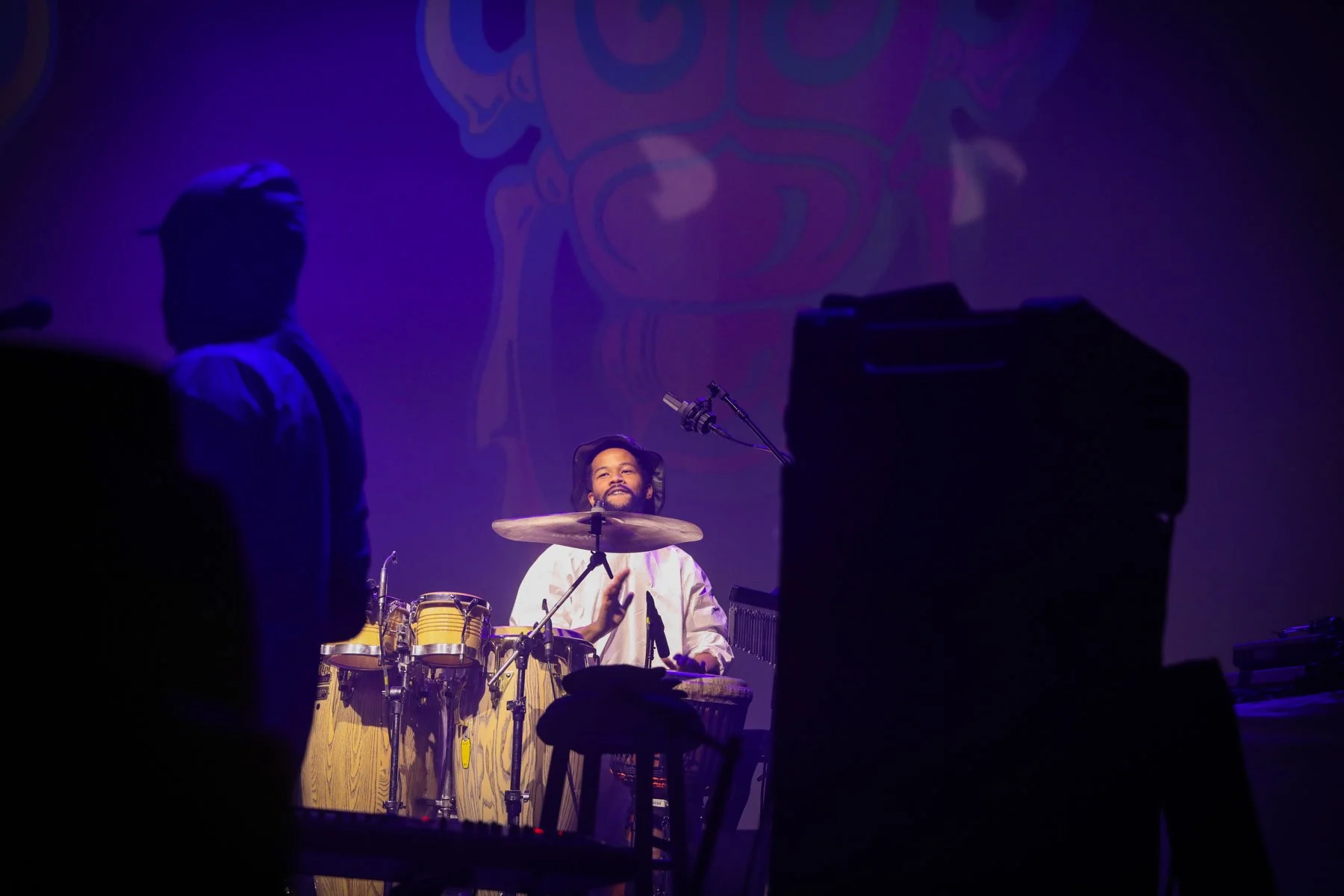


The musicians settled into grooves drawn from soul, funk, R&B, and hip-hop.
The crowd began moving before Badu appeared. Hands rose. Bodies swayed. People smiled at one another across the theater.
“The images can show the lighting, clothing, movement, and expressions. The deeper exchange lives in the experience itself.”
The Queen Enters
Stillness established her authority before the first note.
The stage darkened before a spotlight revealed Erykah Badu.
She did not rush toward the microphone. She paused.
She looked into the room as the audience recognized her presence and responded.
Through my viewfinder, I watched her move toward the equipment positioned at center stage.
Her drum machine and keyboard were not background accessories. They were part of her performance language— tools for building rhythm, manipulating sound, and guiding the musicians around her.
Her clothing carried the same sense of intention. Badu wore a multicolored fringe ensemble filled with yellow, orange, blue, green, and red.
The strands responded to every gesture, catching different colors from the stage lights as she moved. A wide-brimmed dark hat completed the silhouette.
The outfit functioned as wearable art.
It reflected an artistic principle present throughout her career: identity should not be reduced for easier consumption.
A Musical Language Larger Than Genre
Neo-soul is part of the description, not the whole language.
Her music moves through multiple Black musical traditions without treating them as disconnected histories.
Voice
Gospel · Blues · Soul
Gospel phrasing, blues honesty, and the emotional storytelling of classic soul remain inside her vocal language.
Movement
Jazz · Improvisation
She stretches phrases, leaves space between words, changes familiar melodies, and allows songs to respond to the room.
Foundation
Funk · Hip-Hop · R&B
Rhythm, production, live instrumentation, and electronic tools operate as parts of the same conversation.
The evening moved through songs including Hello, On & On, Love of My Life, Otherside of the Game, Bag Lady, Window Seat, Phone Down, Tyrone, and Next Lifetime.
The songs were familiar, but they did not feel frozen in their recorded forms.
The musicians expanded them, shifted their rhythms, and created space for improvisation.
The composition provides the foundation, but the performance responds to the room.
The Visual Archive
Silhouette, equipment, expression, and wearable art.
The photographs preserve some of the most visible elements of the evening: Badu’s wide-brimmed silhouette, multicolored fringe, electronic tools, violet-blue stage light, and the expressions between musical gestures.


Making Peace With “Tyrone”
The joke changed when I listened more carefully.
My first name is Tyrone, so naturally, Badu’s song has followed me for years.
People hear the name and begin singing the chorus or making the familiar joke. I used to feel a certain way about it.
Eventually, I listened more carefully.
The person being criticized in the song is not Tyrone. Tyrone is the dependable friend with transportation— the man the irresponsible boyfriend is told to call after being put out.
Tyrone may have been the reliable one all along.
Hearing thousands of people sing the song together inside the Fox Theatre made the moment even more personal.
I could photograph the performance professionally while still recognizing the humor in sharing a name with one of the most memorable references in modern R&B.
The Painting That Reached the Stage
Art moved through the room in both directions.
One of the evening’s strongest community moments came through St. Louis visual artist Kyla Hawkins.
Hawkins and her supporters held a painted portrait of Badu above the crowd, using phone lights to make the artwork visible from the stage.
Eventually, Badu noticed it. She received the portrait and raised it for the audience to see.
The crowd responded immediately.
A local artist created work inspired by a national artist. The audience helped bring it forward. The performer acknowledged it publicly.
Audiences are not only consumers. They create, respond, document, interpret, and add new meaning to what they experience.
That is how cultural ecosystems remain alive.
From the Photo Pit to the Audience
Sometimes the camera helps me understand. Sometimes it needs to come down.
Once the permitted photography period ended, I packed away my equipment and remained for the rest of the performance.
Watching through the frame.
During the opening, every image had to count: expression, light, stage language, clothing, equipment, and gesture.
Experiencing without the viewfinder.
Without the camera between us, the performance could be experienced as a listener and as a member of the community.
The band moved freely between programmed rhythm and live instrumentation.
Badu guided the show through humor, improvisation, familiar records, deep cuts, and reinterpretations of Black musical history.
Technical issues arose during the evening, but she handled them without allowing the energy to collapse.
She communicated directly with the sound team and continued shaping the performance in real time.
Live music is never completely controlled. It depends on listening, adaptation, trust, and the ability to recover without losing the audience.
Music as Medicine
Private survival became public gathering.
The importance of the evening cannot be separated from its time.
The pandemic had interrupted the entire live-performance ecosystem. Musicians lost work. Venues closed. Audiences became isolated.
Photographers, journalists, engineers, promoters, stage crews, and vendors all felt the effects.
During that period, Badu created interactive performances from home, using technology to remain connected to listeners.
When those songs returned to a full theater, they carried new meaning.
Isolation had become community. Recorded sound had become shared vibration again.
St. Louis understands this function of music.
The city’s blues history teaches that pain can be transformed by giving it rhythm and language.
Jazz teaches us how to move through uncertainty. Soul music reminds us that vulnerability can become strength.
Badu’s performance brought those lessons together.
The Final Frame
The photographs hold the visual evidence. The larger story exists between them.
The photographs from the Fabulous Fox preserve the wide-brimmed hat, the multicolored fringe, the lighting, the musicians, the equipment, and Badu’s command of the stage.
But the larger story exists between the images.
It lives in the audience returning to a theater.
It lives in a local artist’s painting reaching the stage.
It lives in a band rebuilding the feeling of community through rhythm.
It lives in a city remembering that music is not simply entertainment.
“It is infrastructure, memory, ceremony, and healing.”
Erykah Badu did not merely perform in St. Louis that night.
She helped the room feel alive again.
Continue Through the Archive
Follow the artist, the stage, and St. Louis music memory.
Continue into related live-performance stories, stage photography, and the broader BLINK STL archive.
Jazzy Nights & Blues
Follow the music.
Jazz, blues, soul, R&B, funk, artists, venues, and live musical memory.
The Stage
Enter the performance archive.
Musicians, concerts, stage light, live movement, venues, instruments, and performance atmosphere.
BLINK STL
Follow St. Louis stories.
Artists, neighborhoods, communities, venues, public culture, and regional visual memory.
Editorial Credits
Zire Photography and Graphics
